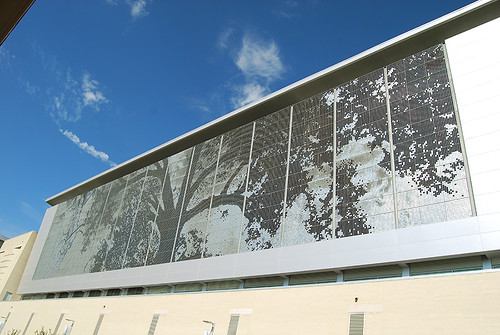
Raleigh: The City as an Oak Tree

Shimmer Wall

I spent my New Years weekend in my adopted hometown of Raleigh. I watched as they dropped an acorn to ring in the New Year, a nod to the city’s designation of the “City of Oaks”. I hung around for a couple of extra days as well to chill out. As part of my vacation, I was banned from using my computer or tablet and ordered to go window-shop and relax.While on that 24 hour sabbatical from my most trusted device, I begin to think about how Raleigh itself has the planning structure of a tree.

Downtown literally is at the bottom of the city, forming the roots. Then, the universities and the older suburbs inside of the beltline(I-440) make up the trunk of the tree. All of the suburban roads that start at the beltline (Glenwood Ave. Extension(US 70), Wake Forest, Six Forks, Capital, Falls of Neuse, New Bern, etc.) make up the branches. Occasionally, you have a Milbrook or a Lynn Rd as cross branches and the branches are sort of framed between the beltlines(I-540 is the outer beltline).

With this pattern in mind, other parts of Raleigh’s sprawl come into play. Each branch has a lot of flowers(flowers being grocery, service retail, schools, churches and occasionally a mall). Branches also have many, many leaves (residential space). Yet, just like a real tree, some branches connect, but others never will meet. Branches will fall, but they return to life. I think of both downtown and North Hills as examples. 12-13 years ago, both were almost dead, now they are the center of a new energy. The universities and their innovations, as well as the laws made at the General Assembly water the roots and seeds that fall from the branches fuel nearby areas (RTP, Cary, Durham).

What do you think? What implications does this idea have on planning for the future in Raleigh? Does this bring some sense into the chaos that Raleigh seems to be sometimes?

Photo Above of the Shimmer Wall of the Raleigh Convention Center. Credit: Flickr user JeffreylCohen via a CC BY-NC-ND 2.0 license.

The Black Urbanist is written by me, Kristen E. Jeffers. I hold a Master of Public Affairs focused on community and economic development from the University of North Carolina Greensboro, which I just finished in May of 2012. I graduated with a Bachelor of Arts in communication with a concentration in public relations from North Carolina State University in 2007. My main gig is being the Public Affairs Officer for the North Carolina Humanities Council, which I also started in May of 2012. I released my first e-book, "Killing the Civic Inferiority Complex" in May of 2012. In May of 2011 I presented at my first CNU NextGen on Cultural Urbanism. At the 2012 CNU, I debuted the concept of the Civic Inferiority Complex. Also in 2012, I spoke at the UNC Global American South conference on the reverse migration of African Americans. I am a featured contributor to "The Atlantic Cities" and "Sustainable Cities Collective." I have also contributed articles to "Grist", "Next City", "Better! Towns and Cities", and "Urban Escapee."
pub-8897335176358686
  • http://twitter.com/acnatta/status/156597993125052416/ André Natta (@acnatta)

    Interesting concept; what say you? @blackurbanist looks at “The City as an Oak Tree” - http://t.co/1mxsfRsk

The Case for a Lazy Urbanism

Urbanism should be second nature, not bound by jargon or complex activities.

Development Types Are Not an Euphemism for Race

ShareDuring a conversation at the recent Streetsblog training in Kansas City, I mentioned again the story of why the site [...]

Transit + Roof + Food + Education + Job + Proximity + Sense of Place = Good Life. A Broken Equation?

It shoudln’t be, but sadly, in many cities, it is.

Guest Post: Yes, A City Can and Should Have It All.

Graham Sheridan, masters candidate in public administration at Brown University, takes my civic-infereiorty complex to task and demands that a city can and should have it all.

Why Do Southerners Go Crazy Over Snow?

Because it happens just enough to both enchant us and drive us crazy.

Mixed-Use Ain’t Always Pretty

Let’s not fall into the trap that mixed-use is only a building code or type.