
A study of urban political systems is a study in the history of cities spitting out or sectioning off their least desirables, namely lower class and people of color of any class. First, it was the gentry of the streetcar era that found they could move further away from their servant class. Then it was housing covenants that kept out non-whites from post-war suburbs. The 1960s brought urban rewewal and slum clearance. Today, we have people who are underwater in shoddy built suburban houses because the city was such a bad place, we needed to get everyone out. Meanwhile, shiny new condos and apartments are filling cities. Sadly, or should I say ironically, some of these places are failing to sell units. A great primer on this history is the textbook City Politics: The Political Economy of Urban America by Dennis R. Judd and Todd Swanstrom.
One major example of failed “urban renewal,” which I was not familiar with until recently, is the World Trade Center complex. The area was a vibrant neighborhood until the Port Authority decided to start being a real estate developer instead of a promoter and operator of decent ports and commuter subways. City Journal has more details on how the taxpayers of New York are dealing with a potential white elephant, which now has not just one, but two tragic events attached to it.
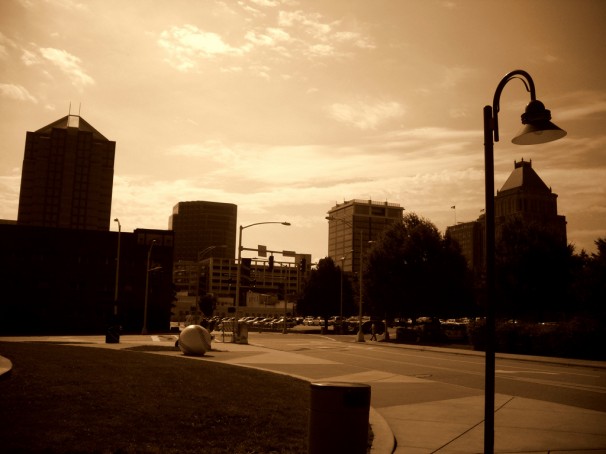
Another example of modern urban renewal is the “entertainment district” that many downtowns have become, including my own. As a woman, I can do all of my shopping downtown, and there are a couple of affordable boutiques. Yet, men are out of luck. Outside of thrift stores, there are no suit shops for men. The restaurants have a new allure, yet, we don’t have shiny new stores downtown at all. I love the local consignment shops and the old theater that plays classic movies. Yet, what about the chain stores that fill our shopping malls and power centers that attract the mass majority of the population?
Once upon a time, downtown was the shopping mall. Department stores were locally owned and did not pay workers inhumane wages. Another concept that’s now foreign downtown is the supermarket. The farmers market we had was great, but it only operates in the summer. What am I supposed to do about fresh food during the winter months if I want to be true to my walkable, urbanist principles? What if I had no car because I was broke, but I was trying to live in a place where everything was close by? Downtown looks cute architecturally, but it far underperforms for the style of real estate it contains.
Those are the surface problems with cities pushing folks out. The real problems come when the suburbs they come into are suburbs in the truest since of the word. They were only subdivisions to begin with and there are no centralized services, shops, or even schools. People complain about parents not coming to schools in low-income areas. The suburbs make it worse by forcing these people to go even further to their schools, possibly via a non-existent bus. What does one make of the dead Kmarts and dead Borders that were so hot when the demographics of the neighborhood were different? Granted, Borders was part of an overstreched business model, but the one in the “inner-ring” suburb I grew up in, up the street from the dying mall, died first.
So hence why I fault those that want to willingly be part of a failing system that traps people. Many suburbs are truly towns and offer people services in walking distance, as well as concern for all it’s citizenry. Yet, too many suburbs are housing subdivisions with nothing to offer. With cities that practice covert forms of urban renewal and suburbs that don’t want to recognize their role as small cities or big towns, we are left with not only suburbs of self-hate, but hateful, hostile cites as well.
One last note before I close out this post. Posts like this and my previous post expose how different governments consider one place a town, a city, or a suburb. I see Greensboro as one big suburb with two to four walkable urban areas, some with all the necessary services such as Lindley Park and others without such as Downtown proper. In other states, a suburb may be an actual city such Alexandria, VA, but thanks to the media, overshadowed by it’s neighbor across the Potomac River.
Either way, there is no excuse for governments of any type to contribute to the demise or the migration of their citizenry. Putting a subdivision next to a landfill, selling out downtowns to one developer, and continuing to pursue loop roads that are known contributors to sprawl are not good. Governments, as well as residents, need to come to terms with being good citizens. Stop stealing, whether it’s your neighbor’s car or “prime land” that’s already a small-scale, but thriving community.
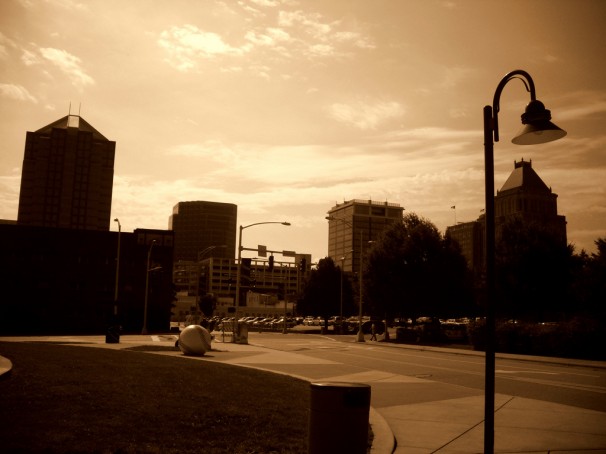
Photo of Downtown Greensboro by Flickr user dmattphotography.